


Abstract
Keywords:
venous leg ulcer, lymphedema, lymphatic dysfunction, phlebolymphedema, compression therapy, bibliometric analysisIntroduction
Venous leg ulcers are among the most persistent and resource-intensive complications of chronic venous disease. They cause prolonged morbidity, repeated clinical visits, and a marked burden on patients and health systems (1,2). The usual pathophysiologic explanation focuses on venous hypertension, ambulatory venous pressure, microcirculatory inflammation, and impaired tissue repair (1). This framework is essential, but it does not fully describe the chronic edema phenotype seen in many patients. In advanced venous disease, lower-limb swelling is rarely a purely venous event. Persistent capillary filtration may exceed lymphatic transport capacity, producing lymphatic overload, secondary lymphatic damage, and the mixed venous-lymphatic state often described as phlebolymphedema (3,4).
The clinical importance of this overlap is clear. When lymphatic failure is present, edema may become more persistent, lymphorrhea more difficult to control, and tissue fibrosis more established. These changes can contribute to an increased susceptibility to cellulitis, delayed epithelialization, and recurrent ulceration (3,5,6). Compression therapy therefore does more than reduce venous hypertension; it also promotes lymphatic drainage and remains central to both venous and lymphatic care pathways (2,7,8). Despite this, many venous ulcer studies do not formally assess lymphatic dysfunction, report edema phenotype, or identify lymphedema as an outcome modifier. The condition is often recognized clinically but may be underrepresented in the literature (5,9).
This study presents a bibliometric analysis of PubMed-indexed literature on venous ulceration and lymphedema. The aim was not to perform a treatment-effect review but to clarify how often the venous-lymphatic relationship is explicitly reflected in publication titles, journals, and thematic patterns.
Materials and Methods
Data Source and Search Basis
A PubMed search was conducted on June 4, 2026, using combined search terms for venous ulcer and lymphedema. The resulting records were exported as a comma-separated values (CSV) file for analysis. The export included publication year, journal title, authorship fields, digital object identifier (DOI), PubMed Central identifier (PMCID), and title fields.
Data Processing and Statistical Analysis
The exported CSV file was analyzed in Hex.tech (Hex Technologies Inc., San Francisco, CA, USA) using Python for data cleaning, sorting, and tabulation. Descriptive statistics were used to characterize the dataset; results were reported as absolute frequencies, relative frequencies (percentages), and count distributions by year, journal, and thematic category. No inferential statistical tests were performed, as the study aimed to describe the bibliometric profile rather than to test hypotheses. Automated keyword matching was not used; thematic classification was performed by manual review of each record's title according to the predefined category list described below. The unit of analysis was the individual PubMed record.
Thematic Classification
A title-based thematic classification was applied to identify the major themes represented in the literature:
Direct venous ulcer/lymphedema overlap
Lymphedema or lymphatic terminology
Venous ulcer terminology
Compression therapy
Wound care or healing
Guideline, review, or algorithm publications
Surgical or interventional lymphatic approaches
Case reports, pilot studies, or clinical trials
Results
Overall Bibliographic Profile

The dataset contained 200 PubMed records published from 1955 to 2026 (as of June 4, 2026), distributed across 105 journals (Table 1). A DOI was available for 122 records (61.0%), while 26 records (13.0%) had a PMCID. There were 181 unique first authors, indicating a dispersed authorship structure rather than the output of a single dominant research group.
Temporal Trend
Publication activity was sparse and irregular before the 1990s and increased more substantially after 2010 (Figure 1). The largest annual totals occurred in 2016 and 2025, with 11 records in each year. Direct title-level overlap between venous ulceration and lymphedema remained consistently low, even in years with higher overall publication activity.


Although overall publication volume increased after 2010, the proportion of records using lymphedema or lymphatic terminology remained variable across decades (Figure 2). In the earliest period (1955–1989), lymphatic terms appeared in only a small fraction of the sparse output. From the 1990s onward, the use of lymphedema or lymphatic terminology became more consistent, with three of four records in 1996, three of 11 records in 2016, and four of 11 records in 2025 containing these terms. The direct venous ulcer and lymphedema overlap was limited to five individual records across the entire dataset (1955, 2007, 2023, 2024, and 2025), suggesting that the combined topic has only recently begun to appear in publication titles.
Journal Distribution


The most frequent journals were J Wound Care and Phlebologie, with 18 records each, followed by Br J Community Nurs and Br J Nurs, with nine records each (Figure 3). Nursing, vascular, dermatology, wound care, and microsurgical journals were all represented among the leading sources, reflecting the multidisciplinary nature of the topic.
Thematic Structure
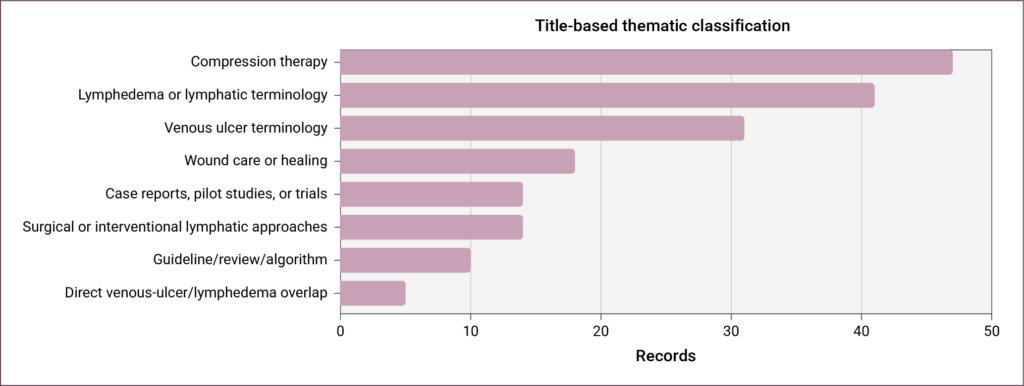
The most frequent title-based categories were compression therapy (47 records, 23.5%), lymphedema/lymphatic terminology (41 records, 20.5%), and venous ulcer terminology (31 records, 15.5%) (Figure 4). Direct venous ulcer/lymphedema overlap was identified in five records (2.5%) using the title-overlap definition. Wound care/healing terminology appeared in 18 records (9.0%), guideline/review publications in 10 records (5.0%), surgical/interventional approaches in 14 records (7.0%), and case reports, pilot studies, or clinical trials in 14 records (7.0%).


Discussion
Three practical areas dominate the literature. The first is compression therapy, which remains the shared foundation of venous and lymphatic management (2,7,8). The second is wound care, where publications address exudate, healing, dressings, and chronic ulcer management, but often without formally phenotyping lymphatic dysfunction (1,6,9). The third is a smaller interventional field focused on lymphatic surgery, including lymphovenous bypass and lymphovenous anastomosis, mainly in selected chronic or refractory cases (10–13). Importantly, treatment-pattern analyses suggest that lymphatic therapy may be undervalued for patients with phlebolymphedema and venous leg ulcer (14). This distribution may reflect daily practice: many clinicians manage both the wound and the edema, but the lymphatic component is not always separately identified, measured, or reported.

The limited explicit representation of this relationship in the literature is not merely a bibliometric detail. Lymphedema may alter prognosis, compression tolerance, infection risk, and response to standard venous ulcer care (5). Patients with persistent lymphatic failure may need more than venous correction and conventional compression. In selected cases, management may require structured edema staging, lymphatic-specific compression, manual lymphatic drainage, cellulitis prevention, skin-care protocols, lymphorrhea control, lymphatic imaging, or surgical consultation (7,8,10–15). If lymphatic status is not recorded, its influence cannot be accounted for, and clinically meaningful heterogeneity may remain unrecognized.
Future venous ulcer studies should therefore treat lymphatic dysfunction as an important clinical variable rather than an incidental observation. Baseline reporting should include edema phenotype, suspected or confirmed lymphatic insufficiency, history of cellulitis, lymphorrhea, fibrosis or skin changes, compression tolerance, and recurrence. Prospective cohorts could test whether lymphatic impairment predicts delayed healing or relapse after venous intervention. Trials of compression systems and wound care technologies should include lymphatic subgroup analyses. Finally, lymphatic imaging and microsurgical approaches require structured evaluation beyond isolated case reports.
This study has several limitations. First, the analysis was based on PubMed records only; inclusion of additional databases such as Embase, CINAHL, or Scopus might yield a larger or differently structured dataset. Second, the title-based thematic classification relied on keyword presence and did not capture themes discussed within abstracts or full texts where the venous-lymphatic relationship may have appeared without being named in the title. Third, the dataset includes records across seven decades with evolving terminology; earlier records may have used different terms for overlapping concepts, potentially underestimating the true overlap. Fourth, bibliometric metadata do not capture the depth of clinical discussion; a study may address lymphatic impairment extensively in its text without including relevant terminology in the title. Finally, the search was conducted at a single time point, and newly published or indexed records may alter the distribution.
Conclusion
Venous ulceration and lymphedema are closely connected in clinical practice, but their explicit overlap remains underrepresented in publication titles within the PubMed literature. This limited representation matters because lymphatic dysfunction may influence healing, recurrence, infection risk, and response to compression-based care. Venous ulcer research should move beyond a purely venous framework and report lymphatic status more systematically, including edema phenotype and lymphatic-specific outcomes, especially in patients with chronic edema, lymphorrhea, recurrent cellulitis, fibrosis, or refractory wounds.
REFERENCES
Burian EA, Sabah L, Karlsmark T, Kirketerp-Møller K, Moffatt CJ, Thyssen JP, et al. Cytokines and venous leg ulcer healing—a systematic review. Int J Mol Sci. 2022;23(12):6526. [CrossRef]
Sun CR, Liu MY, Ni QH, Cai F, Tang F, Yu ZY, et al. Clinical guidelines on compression therapy in venous diseases. Ann Vasc Surg. 2025;110(Pt B):183–203. [CrossRef]
Bull RH, Gane JN, Evans JE, Joseph AE, Mortimer PS. Abnormal lymph drainage in patients with chronic venous leg ulcers. J Am Acad Dermatol. 1993;28(4):585–90. [CrossRef]
Mortimer PS. Evaluation of lymphatic function: abnormal lymph drainage in venous disease. Int Angiol. 1995;14(3 Suppl 1):32–5.
Moon T, O'Donnell TF, Weycker D, Iafrati M. Impact of lymphedema in the management of venous leg ulcers. Phlebology. 2023;38(9):613–21. [CrossRef]
Aviles F Jr, Faust E. Wound care in venous disease and lymphedema. Nurs Clin North Am. 2025;60(1):77–98. [CrossRef]
Ratliff CR, Yates S, McNichol L, Gray M. Compression for lower extremity venous disease and lymphedema (CLEVDAL): update of the VLU algorithm. J Wound Ostomy Continence Nurs. 2022;49(4):331–46. [CrossRef]
Stanton J. Lymphatic insufficiency and stiff compression in venous leg ulceration. J Wound Care. 2024;33(Suppl. 1):S4–9. [CrossRef]
Gray D, Stanton J, Rouncivell D, McRobert J. Venous and lymphovenous lower limb wound outcomes in specialist UK wound and lymphoedema clinics. Br J Nurs. 2023;32(15):S12–8. [CrossRef]
Cigna E, Pierazzi DM, Sereni S, Marcasciano M, Losco L, Bolletta A. Lymphatico-venous anastomosis in chronic ulcer with venous insufficiency: a case report. Microsurgery. 2021;41(6):574–8. [CrossRef]
Mihara M, Hara H, Todokoro T, Seki Y, Iida T, Koshima I, et al. The effect of lymphatico-venous anastomosis for an intractable ulcer at the lower leg in a marked obese patient. Microsurgery. 2014;34(1):64–7. [CrossRef]
Chao S, Kuan C, Lin Y, Tai H, Cheng N. Lymphovenous bypass as an alternative strategy for managing phleboedema and venous leg ulcers: preliminary results. Plast Reconstr Surg Glob Open. 2024;12(8):e6064. [CrossRef]
Yamagiwa Y, Otani N, Oue T, Shikano Y, Nomori M, Kubo T. Lymphovenous anastomosis using pedicled deep inferior epigastric perforator flap vein for ulcer with lymphorrhea: a case report. Microsurgery. 2025;45(6):e70108. [CrossRef]
O'Donnell TF Jr, Izhakoff J, Gaebler JA, Niecko T, Iafrati MD. Correlation of disease comorbidity with prescribed treatment among insured U.S. lymphedema patients. J Vasc Surg Venous Lymphat Disord. 2021;9(2):461–70. [CrossRef]
Szolnoky G, Tuczai M, Macdonald JM, Dosa-Racz E, Barsony K, Balogh M, et al. Adjunctive role of manual lymph drainage in the healing of venous ulcers: A comparative pilot study. Lymphology. 2018;51(4):148–59.